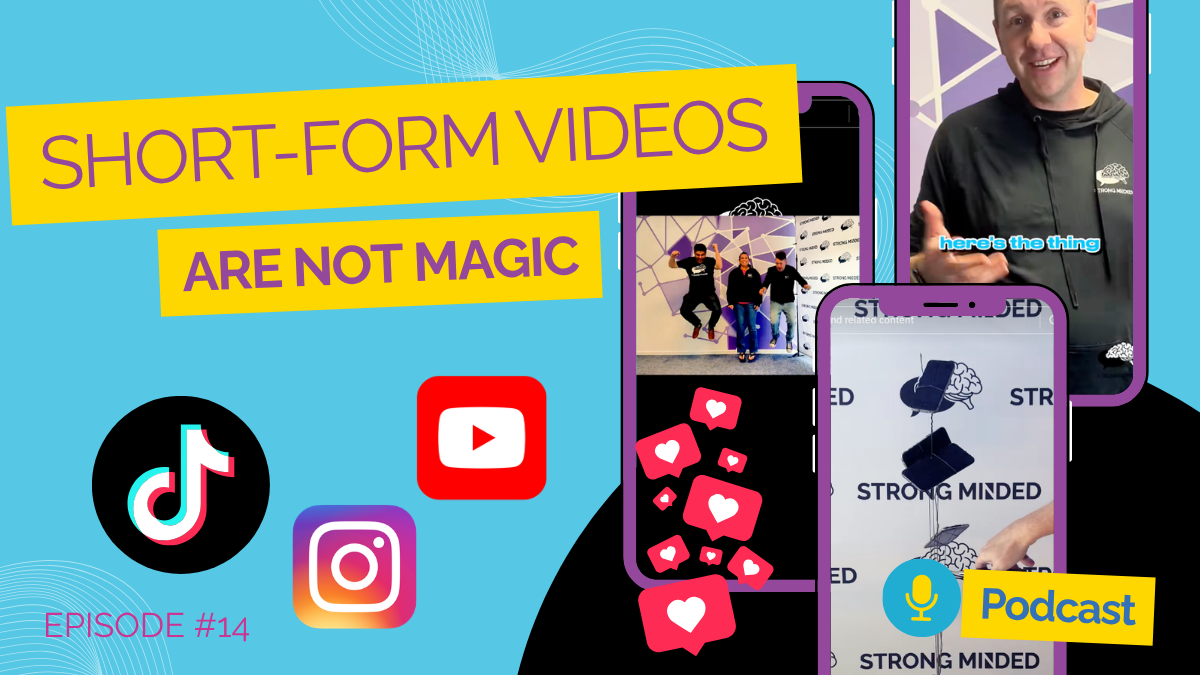
Short-Form Video Is Not Magic
Everyone says your business needs short-form video.
Reels. TikToks. YouTube Shorts. Vertical video. Talking heads. Trends. Hooks.
But just because a video is short does not mean anyone actually wants to watch it.
In this episode of Meeting of the (Strong) Minds, Eric and Jenny break down why short-form video works, why so much of it does not, and what businesses should actually think about before hitting record.
The answer is not simply to make more videos.
You need to give people a reason to stop scrolling.
Listen to the Full Episode
Prefer Apple? Listen and subscribe on Apple Podcasts.
Why Short-Form Video Is So Hard to Ignore
Jenny admits what most of us already know: it is incredibly easy to get sucked into short-form video.
You open your phone with five minutes to kill. One video becomes another. Then another. Suddenly you have watched 20 of them and have no idea where the time went.
Part of the appeal is that every video asks for such a small commitment.
You are not sitting down to watch a 30-minute television show. You are deciding whether to give something another 15, 30, or 60 seconds.
And if you are not interested?
Swipe.
The platforms learn quickly. The more you watch certain topics, creators, and styles, the more similar content they serve you.
That discoverability is exactly why businesses want to get involved.
People are already there.
The question is how your business can enter that feed without looking like it does not belong.
Being Short Is Not Enough
The entire game starts with attention.
You may only have a few seconds to convince someone not to swipe away.
That is where the idea of a hook comes in.
It might be a question.
A strong headline on the screen.
An unusual visual.
A jump cut.
A surprising statement.
Something happening in the first few seconds that makes the viewer wonder what comes next.
Eric points out that there is nothing inherently wrong with hooks. A headline at the top of a video is really not that different from a heading in a blog. It tells the audience what they are about to get.
The problem comes when the hook is the only interesting part.
You still have to deliver something useful, entertaining, interesting, or informative once the viewer stops.
Getting someone to stop scrolling is step one.
Giving them a reason to stay is the part that matters.
Make Sure People Can Actually Hear You
Jenny's biggest short-form video pet peeve is simple: bad audio.
If you are creating video professionally for your business and people cannot clearly hear what you are saying, they are probably not going to work very hard to figure it out.
They will scroll.
The good news is that decent audio does not require a massive investment anymore. Small wireless microphones have become inexpensive and easy to use.
Captions are equally important.
People frequently watch videos without sound, so your message needs to work even when the volume is off.
That gives businesses a basic starting checklist:
- Make sure people can hear you.
- Make sure they can see you.
- Use captions.
- Tell them quickly what the video is about.
None of those things will automatically make a video successful.
But ignoring them can make a good idea much easier to scroll past.
Do Not Chase Every Trend
Short-form platforms are built around trends.
Popular audio. Editing styles. Challenges. Jokes. Dances. Visual tricks.
That does not mean your business needs to participate in all of them.
Jenny makes the point that businesses need to look inward before copying something simply because it is working for somebody else.
Would your company actually do this?
Does it match your personality?
Would your customers understand why you are doing it?
If the answer is no, forcing yourself into the trend can make the company look less authentic rather than more relevant.
Eric agrees that trends can work when they fit the brand.
But views for the sake of views are not necessarily valuable.
A law firm does not need to suddenly start dancing because dancing videos happen to be popular.
A company with a playful personality may have much more freedom to experiment.
The important part is knowing where the line is for your brand before you start creating.
Talking Head Videos Can Work, But You Still Need a Formula
One of the easiest short-form formats for businesses is the talking head video.
Put someone in front of a camera and have them explain something.
That might be a clip from a podcast, an answer to a customer question, a quick tip, or an opinion about something happening in the industry.
They are easy to produce.
They are also easy to produce badly.
Simply putting someone in front of a blank wall and asking them to recite a random fact does not automatically create compelling content.
If the person looks like they are reading from a teleprompter, has no energy, takes too long to make the point, and gives the viewer no reason to care, being on video does not solve the problem.
Talking head videos rely even more heavily on context.
Give people a clear topic.
Ask a strong question.
Move quickly.
Cut unnecessary pauses.
Get to the useful information.
Educational content absolutely has a place on TikTok, Reels, and Shorts.
But educational does not have to mean slow.
Sometimes the Best Short-Form Video Starts Somewhere Else
Podcast clips are a good example.
Instead of sitting someone down and telling them to perform a 30-second speech, you can take a natural moment from a longer conversation.
Maybe someone makes a strong argument.
Someone asks an interesting question.
There is disagreement.
There is a funny story.
The viewer gets enough of the conversation to become curious about the rest.
Jenny describes seeing clips like this and wanting to know how the conversation ultimately ended.
That is exactly what the short-form piece is supposed to do.
The clip stands on its own, but it also gives someone a path toward the longer podcast, video, website, or brand behind it.
Polished vs. Authentic Is Not an Either-Or Decision
Short-form video has also changed what audiences consider acceptable production quality.
Not every business video needs studio lighting, an expensive camera, and a full production crew.
Sometimes pulling out your phone after a client meeting and talking about a question that just came up can produce better content than something planned weeks in advance.
That immediacy can feel more personal.
It can show the people behind the company.
It can make the audience feel like they are getting a real look at what is happening inside the business.
But authentic does not mean careless.
The video still needs to be watchable.
The audio still needs to be understandable.
The camera should not be shaking so badly that people cannot focus.
The idea still needs to be worth sharing.
You can absolutely create a polished video when the concept calls for one and grab your phone when an interesting idea comes up unexpectedly.
The best strategy probably includes both.
Stop Measuring Everything by Viral Views
One of the easiest ways for businesses to get discouraged is by looking at views.
You put time into a video.
You publish it.
One hundred people watch.
It can feel like a failure because we have become accustomed to seeing videos with hundreds of thousands or millions of views.
But Eric reframes that number.
If you rented a room and 100 people showed up to hear your business talk about something, would you consider that a failure?
Probably not.
Most small businesses are not trying to become influencers.
You are not relying on TikTok or YouTube to pay you based on the number of views.
You are trying to build awareness, demonstrate expertise, reach potential customers, and stay visible.
That makes the quality of the audience more important than the size of the number underneath the video.
"I'd much rather have a hundred views of people that are in my market than a thousand views of people that have no interest in buying anything from us."
Eric Hersey
Going viral is not a strategy.
Getting the right people to consistently see useful content can be.
The Algorithm Can Actually Help Small Businesses
One of the biggest advantages of modern short-form platforms is that someone does not necessarily have to follow you before they see your content.
The platforms are constantly trying to identify what people are interested in.
If someone regularly watches Photoshop tutorials, the algorithm will probably show them more Photoshop tutorials.
If someone likes videos about home improvement, travel, human resources, law, food, fitness, or nearly anything else, the system keeps looking for similar content.
That gives businesses an opportunity.
Create useful content about the things you want to be known for.
Do it consistently.
The people watching similar content have a chance to discover you even if they have never heard of your company.
Over time, they may see you repeatedly.
Then they recognize you.
Then maybe they follow you.
And eventually, when they need what you sell, your company is no longer a stranger.
Start With the Questions Your Customers Already Ask
If you have no idea what videos your business should make, Eric offers a very simple starting point.
Think about what customers ask you.
Then answer those questions.
Do not try to fit everything you know into one reel.
Pick one subject.
Get to the point.
Answer it clearly.
Make sure people can see and hear you.
Add captions.
Publish it.
Then pay attention to what happens.
What did people watch?
What felt natural?
What was awkward?
What topics generated a reaction?
Do more of what works and stop spending time on what does not.
Short-form content is generally much more disposable than a television commercial or major campaign. You do not need to spend weeks obsessing over every 30-second video.
You need to start learning what works for your business.
The Strong Minded Agency Take
Short-form video works.
But the format is not magic.
A bad idea does not become a good idea because you made it vertical.
A boring sales pitch does not become interesting because it is only 30 seconds long.
And your business does not need to recreate every trend simply because someone told you Reels are important.
Start with something worth sharing.
Answer a question.
Teach somebody something.
Show them something interesting.
Make them laugh if that fits your brand.
Give them a look behind the scenes.
Show some personality.
Then package that idea in a way that respects the few seconds of attention someone is giving you.
You do not have to go viral.
You just have to give the right person a reason to stop scrolling.
What This Episode Covers
- Why short-form video can become so addictive
- How TikTok, Reels, and YouTube Shorts changed video consumption
- Why businesses need a strong hook in the first few seconds
- Why the hook still needs to deliver real substance
- The importance of microphones, clear audio, and captions
- Why businesses should not blindly chase social media trends
- How talking head videos can work for professional businesses
- Why podcast clips make effective short-form content
- How to balance professional production with authentic video
- Why 100 relevant views can matter more than 1,000 random ones
- How short-form algorithms can help new audiences discover your business
- Why customer questions are one of the best sources of video ideas
- How businesses can start experimenting without overthinking every post
Follow & Subscribe
Want to keep up with the latest episodes? Follow Meeting of the (Strong) Minds wherever you listen or watch:
Need help figuring out what your business should actually be doing with short-form video? Strong Minded Agency can help develop the ideas, record the content, produce the videos, and build a strategy around getting them in front of the right audience.

Recent Posts
Short-Form Video Is Not Magic