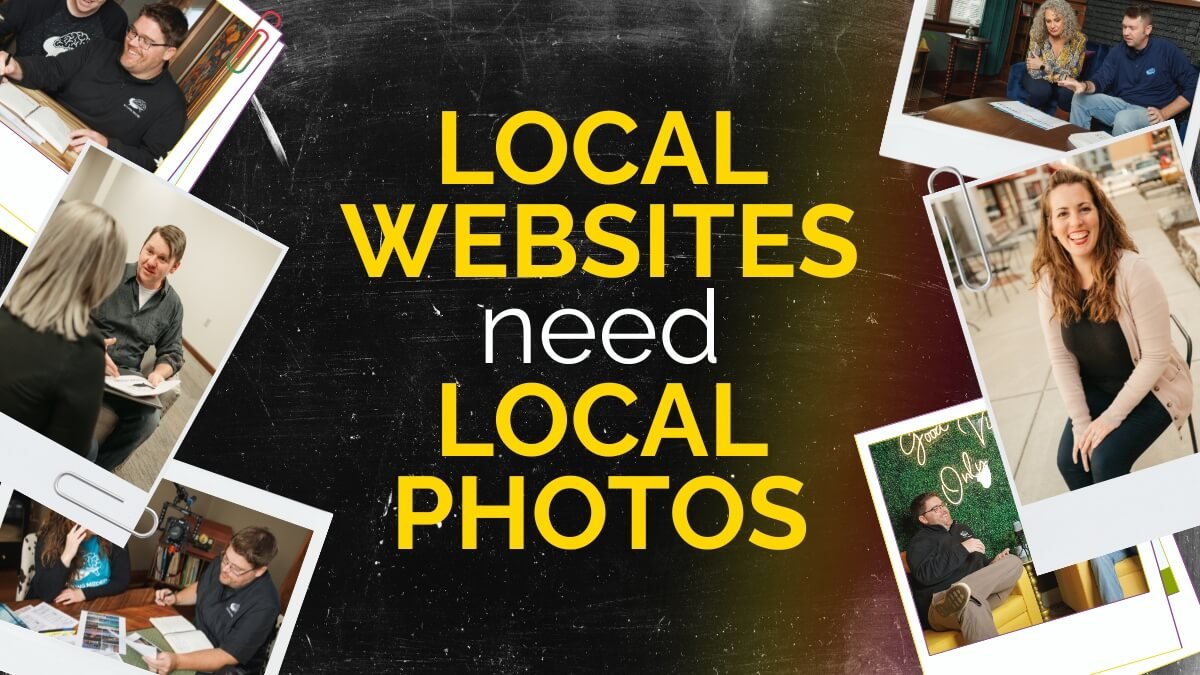
Stop Hiding Behind Stock Photos: Why Local Websites Need Real Pictures of Real People
Within seconds of visiting your website, users should be able to tell if you are a local business.
No, that is not because it is low quality and you did not spend millions of dollars on development.
It really comes down to the images.
A lot of small business owners hear advice like "make it look professional" and assume that means polished stock photos, generic smiling models, staged handshakes, fake office settings, or AI-generated people who look just a little too perfect. The problem is that this kind of imagery might look clean, but it often does not look real. And when a local business stops looking real, it starts losing one of its biggest advantages.
Local people want to do business with local people.
That has always been true, but it matters even more online because your website is usually one of the first places someone decides whether to trust you. Nielsen Norman Group notes that users form aesthetics-driven first impressions of websites in about 50 milliseconds, and that this early reaction shapes how they perceive relevance, credibility, and usability. In separate usability research, the same group also points to design quality and current content as core signals of trustworthiness.
For local businesses, that means your images are not decoration. They are part of your sales process.
Most Local Businesses Already Have a Face. Their Website Just Refuses to Show It
When we build websites for small and mid-sized businesses, one thing comes up over and over again: most of them already have personality. They already have a face. It might be the owner. It might be the lead salesperson. It might be the office manager who everybody knows. It might be the technician customers trust, the attorney clients ask for by name, or the front desk person who makes everybody feel comfortable.
Very rarely do you run into a real local business that is completely faceless.
That matters because people naturally gravitate toward people. Even giant brands often become associated with recognizable individuals. Apple is still deeply tied to Steve Jobs in the minds of many consumers. Disney is still associated with Walt Disney. The Muppets are tied to Jim Henson and to characters people can immediately picture. Big companies understand the power of a face, a voice, and a personality. Local businesses should not ignore that same principle just because they are operating on a smaller scale.
In fact, local businesses may benefit from it even more. A local company does not need to pretend it is some giant national brand. It needs to look approachable, knowable, and human. That is often what makes it better.
Stock Photography Is Usually the Fastest Way to Look Generic
The issue with stock photography is not that every stock image is automatically bad. The issue is that most local businesses use it in the most predictable way possible.
- Law firms use gavels and men in suits shaking hands.
- Contractors use hard hats and clipboards.
- Medical offices use smiling models who clearly do not work there.
- Restaurants use generic food that does not match the menu.
- Service companies use photos that could belong to literally any company in America.
After a while, all of these websites start blending together.
That sameness hurts trust. Getty Images reported in 2024 that 98% of consumers agree authentic images and videos are important for establishing trust, and nearly 90% want transparency around AI-generated imagery. Getty also advises that when a message depends on authenticity, representation, real people, or real connection, AI-generated visuals are not the right fit.
That lines up with what most people already feel instinctively. Visitors may not always say, "this photo is fake and therefore I distrust this company," but they absolutely pick up on the vibe. They can tell when a website feels overly staged, too polished, too generic, or disconnected from the actual business.
And if your first impression feels fake, people start wondering what else is fake.
Local Does Not Mean Sloppy
This is where some businesses get tripped up.
When people hear "use real local pictures," they sometimes think that means the site should feel homemade, random, or less professional. That is not the point at all.
Looking local should not mean looking thrown together.
A strong local website should still look sharp, well-designed, current, intentional, and credible. It just should not look generic. You are not choosing between "professional" and "personal." The goal is both. The site should look polished enough to build confidence and real enough to build connection.
That is why the answer is not "just have someone in the office snap a few photos on their phone and call it a day." The answer is to work with someone who knows how to make real things look professional.
You Do Not Need a Hollywood Budget. You Need a Plan
The good news is this is not nearly as hard as a lot of business owners think.
- You do not need a film crew.
- You do not need a cinematic commercial.
- You do not need a hundred-page creative brief.
What you need is a plan.
You need to identify the parts of your business people should actually see. That usually includes your team, your space, your products, your work in action, and the kind of customer interactions that reflect what it is like to do business with you.
Then you need a professional photographer or videographer who understands framing, lighting, composition, and marketing. That last part matters. There is a difference between someone taking a technically decent picture and someone taking a useful marketing photo. A family snapshot and a website-ready brand image are not the same thing.
A pro knows how to make the environment feel real while still making it look its best. They know what angles flatter a space. They know how to capture people interacting naturally. They know how to make food look appetizing, products look desirable, and services look believable.
That is the difference.
Real Customers, Real Team Members, Real Use Cases
One of the smartest things a local business can do is show the kinds of people it actually serves.
- If you want to attract 45 to 55-year-old men, it helps to actually show 45 to 55-year-old men in your imagery.
- If your ideal customer is a family, show families.
- If your business serves seniors, show seniors.
People want to see themselves in your marketing.
That is one reason authentic content performs so well. Stackla research found that 83% of consumers say businesses need to provide more authentic shopping experiences, 72% say photos and videos from real customers are the content they most want to see on ecommerce sites when making purchase decisions, and 58% say they have left a brand website without buying because it did not contain customer reviews or photos. The survey focused on online shopping, but the broader takeaway is useful for any business website: people want proof that other real people are already there.
For a local business, that does not mean your homepage should turn into a social feed. It means your website should not feel sterile. It should show evidence of real life.
Your Products Should Look Like Your Products
This is especially important for businesses that sell something visual.
If you are a restaurant, do not use a generic salad from a stock library when you could show your actual salad.
I promise you that if you use a generic picture of a salad, that user is going to head online and try and find a user-generated image of that salad. I would place bets that the image the customer provides is not going to look as pretty as something you would provide.
Take the time and stage your products. Make sure it looks like the best version of your product. Even if you cannot promise this every single time it is produced, this sure beats some stock photo that we know is not yours.
Remember, customers are not just evaluating your product or service. They are evaluating whether your business feels legitimate, current, and trustworthy.
Generic imagery says, "we needed to fill space." Real imagery says, "this is who we are, this is what we do, and this is what it looks like."
AI and Fake Visuals Create a New Trust Problem
This issue gets even bigger now that AI image tools make it easier than ever to fake authenticity.
- Yes, you can put your logo on a generated shirt.
- Yes, you can create a fake smiling customer.
- Yes, you can build a polished hero image in minutes.
But the easier that gets, the more valuable real photography becomes.
Clutch reported in early 2026 that 84% of consumers want brands to disclose AI imagery, and acceptance drops as the content moves closer to depictions of real life. So if you are going to use AI, you better clearly disclose that it is not real. That may not be the first thing you want customers to see.
A local business already has something AI cannot truly replicate: actual people, actual customers, and an actual presence in the community.
Use that.
The Best Approach Is Collaborative
One of the easiest wins for a small business is to have its web designer and photographer work together.
That way, the photo shoot is not random.
Instead of taking a bunch of nice-looking photos and hoping they fit later, you can plan around what the website actually needs:
- Portrait images for team pages
- Wide landscape shots for banners
- Interaction photos for service pages
- Detail shots for products
- Location shots for trust
- Vertical crops for mobile and social use
That is how you avoid wasting time and money.
You also get better buy-in from the team when the process feels organized. People are much more likely to participate when they know why the photos matter, how they will be used, and what the business is trying to accomplish.
And if you need customers in the shoot, ask. Many businesses are surprised by how willing customers, friends, family members, and loyal supporters are to help when the ask is simple and respectful. Sometimes lunch and a fun afternoon are enough to make it happen.
This Is Not a One-Time Project
A lot of businesses make one more mistake: they do a photo shoot once and then treat those photos like they should last forever.
They should not.
- If the photos on your website are seven years old, people notice.
- If the office looks different now, people notice.
- If the person at the front desk looks completely different, people notice.
Current content is part of trust. Nielsen Norman Group specifically identifies current content as one of the enduring signals users rely on when judging whether a site is trustworthy.
That means updated photography is not vanity. It is maintenance.
A business does not need new brand photos every month, but every couple of years should be considered normal. A few refreshes throughout the year is even better if the budget allows. Websites should reflect the business as it exists now, not the business as it looked before a remodel, before a staff change, or before the brand matured.
What This Really Comes Down To
A local website should not feel like it was assembled from whatever was lying around in a stock library.
It should feel like the business.
- It should show real people.
- It should show real spaces.
- It should show real products.
- It should show real interactions.
- It should make someone think, "Yes, this feels like a real company I can call."
That is the standard.
Professional local photography is not about being fancy. It is about being believable. It helps your business look more approachable, more current, more confident, and more trustworthy. And when trust is the thing standing between a visitor bouncing and a visitor converting, that matters a lot.
If a small business wants a better website, one of the smartest places to start is simple: stop hiding behind stock photos and start showing people who you really are.

Recent Posts