Why Keyword Tracking Still Has a Place in Modern SEO
This post was written in Microsoft Word over the course of an afternoon, not in ChatGPT. Yes, this was done by a human - with just a little assistance by AI to cleanup some grammar.
Is keyword tracking really necessary these days?
Google has said that 15% of daily searches are entirely new queries. Every single day, there is a new string of words put together and searched that was never searched before. I find that stat quite amazing.
And nowadays, search engines are so good at customizing results based on location and previous searches, how can we possibly track a single keyword and get back a result that is absolutely in the same position for each search?
I don’t think you can…but I also don’t think you should stop tracking keywords.
What Is Keyword Tracking
Because of all of the factors that go into a search engine results page, it’s a bit difficult to just search on your home computer for a keyword and know that’s what the bulk majority is going to see. Believe me, I have to explain this to clients ALL of the time.
- If you are searching from inside of your business, there is a good chance you might show up number one in the map pack.
- If you are searching for your industry, you may or may not create a bias for your company website based on your previous visits.
- Just because you went incognito does not mean that the results will be exactly what everyone else sees.
I, for one, would absolutely love for it to be that easy. We would save a pretty penny on marketing tools if we didn’t have to try and emulate real searches.
Most digital marketers find great value in looking at overall rankings based on keywords. In order to do this properly (and not just rely on the data Google gives you in Google Search Console), you should subscribe to a tool that allows you to track specific keywords and where your website ranks for those keywords.
This can get pricey. Some of the entry-level tools start at $50–$100 per month, but as you build up your keyword list, they can jump to over $500 per month. And keyword tracking is not as simple as just entering “service.” If you want real results, you need to add variations and locations.
The more keywords and variations, the more money it costs.
Why Is Tracking Keywords Important?
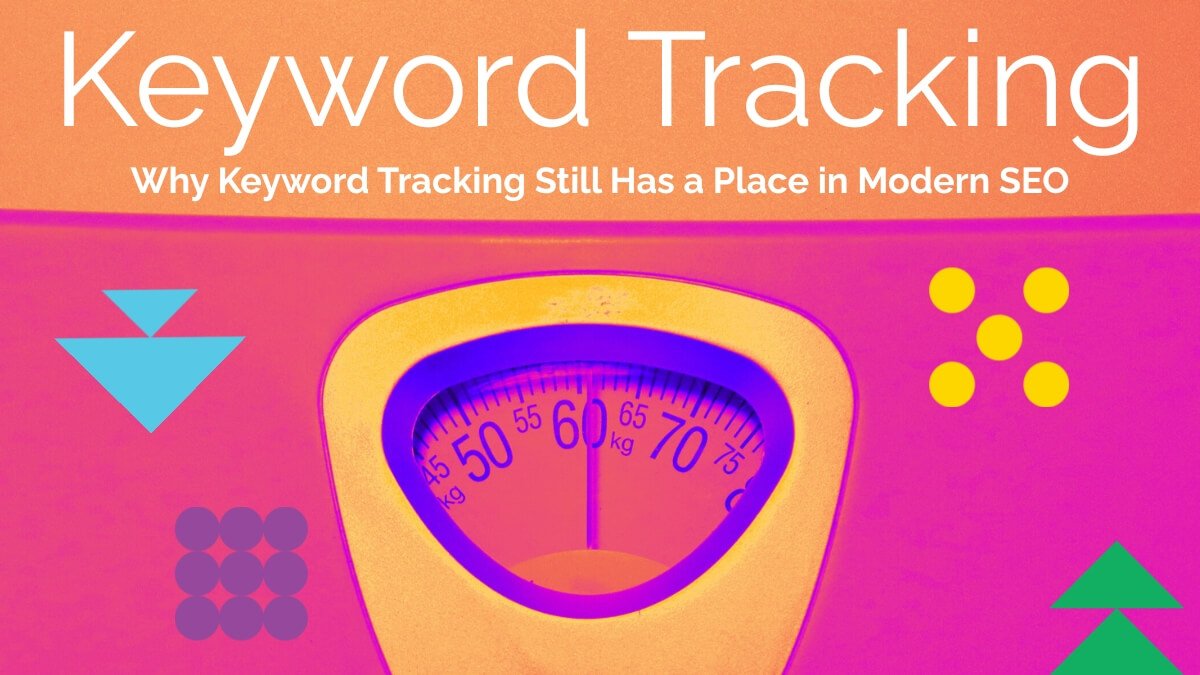
Have you ever gone on a diet? Yeah, dumb question. Most of us have, and most of us buy a scale to record our progress. The scale does absolutely nothing to help us achieve the actual goal, but it does let us know when we are moving in the right direction. Tracking keywords is a bit like the scale.
To continue with our lovely diet metaphor, exercise and eating properly are the actual actions that help us lose weight. We get a bit excited when our pants fit a little better and that second chin starts to go away. Sure, we don’t really need a scale to tell us how much we weigh once we start seeing these results, but as many of us know, progress doesn’t happen overnight.
If you are looking to increase your website’s ranking for specific terms, you need to watch what you eat and exercise (which might be updating your service pages and getting your website linked on industry directories). You might work really hard one week to make this happen, but still don’t see a huge improvement. Your pants are still tight, and your website doesn’t seem to be getting any additional traffic. Maybe a few weeks of this has you getting back on the couch and giving up.
But that scale usually gives you small signs that things are going well. Losing one pound won’t always move you one notch in your belt, but it keeps you motivated and knowing that things are working.
Tracking your keywords and seeing that your website went from position 89 to 79 won’t change your traffic much, but it shows that your work is moving you in the right direction.
How Do You Know What Keywords to Track?
Back in the day (pre-ChatGPT), keyword research was quite the mental exercise. I’m not saying it’s an absolute cakewalk now, but boy does AI help you get the process started and organized a lot quicker.
Finding the keywords that matter for your business gets tricky when you really start hammering things down. Sure, you probably want to rank for your business name and every service that you provide. That helps you get a list started.
But then you start thinking about keyword stemming (adding prefixes or suffixes to cover variations). You start writing down long-tail keywords - the longer phrases someone would type in to get a better result. You start to wonder if “attorney” and “lawyer” count as the same thing. Things get complicated and ugly real quick. You end up with 2,000 keywords you want to track and a bill for $10,000 per year from Moz.
And for some, this works. Track everything. For most of us, that’s way too much, and you would have to dedicate 40 hours a week just to review these reports. Not to mention that a lot of this tracking ebbs and flows from week to week.
The best answer (for most small businesses) is to start small and build your way up. Start with your services and where your primary audience is searching from. For Strong Minded, we might start with “Advertising Agency” and have it geo-tagged in Wheeling, West Virginia. If the tool doesn’t have an option to tag a location, we would just make the phrase “Advertising Agency Wheeling WV.”
If you go through your major services and some of your major cities, you might end up with 50 solid keywords to track. In a day, week, or month (yes, the cost is usually dependent on how frequently you run these reports), you will find out where you rank and how much work you need to do.
Instead of focusing on 500 keywords at once, let’s see where you are and start focusing on one cluster at a time.
Clustering by Service and Location
Yes, a single keyword helps you gauge improvement, but grouping them together by service or location can also help you track your momentum. How you do this is entirely up to your preference, but sometimes it’s nice to look at your reports and see that you increased an average of 15 spots in Steubenville for web design terms but haven’t moved an inch in Moundsville for the same terms. Why is that? That’s when you investigate.
Each tool is different. Some use categories and others use tags. You can get really specific, but don’t make it harder on yourself. Services and locations are usually a good starting point.
What About Searches on ChatGPT, Claude, Gemini, and Other AI Tools?
I think this is where most people have started to question keyword research and tracking. People are having these in-depth conversations in AI platforms. We might not head to ChatGPT right now and say “plumbers near me,” but we are having conversations about why the toilet isn’t flushing. We might be tracking “toilet won’t flush” as a potential keyword, and there isn’t a list to rank from within ChatGPT. How are we supposed to know how well we’re doing in these AI chats?
Tools like Moz, SEMrush, and SE Ranking are not able to give you rankings based on AI answers. Instead, they are shifting toward brand mentions in AI Overviews, AI Mode, and ChatGPT. It’s less about the keywords and more about the mentions.
These tools will continue to advance and come up with new ways to track success, but for now, don’t get too hung up on knowing exactly where you rank for a specific keyword.
What Keyword Tracking Still Tells You
Keyword tracking was never meant to be a perfect representation of what every single person sees in search. It’s a directional tool. It tells you where your website is gaining traction, where it’s stagnant, and where it might need more attention.
At the end of the day, keyword movement is still tied directly to what you’re doing on your website. Clear service pages. Helpful content. Strong internal linking. Location relevance. Authority signals. If rankings are improving, it’s usually because something on your site is improving. If they’re falling, it’s often a sign that competitors are doing a better job answering the same questions.
That insight is valuable, even if the numbers aren’t perfect.
AI search doesn’t change that reality. Whether someone finds you through Google, an AI Overview, or a conversational tool like ChatGPT, the systems behind those answers are still pulling from websites that explain things clearly, thoroughly, and accurately. What works for traditional search still works for AI-driven discovery.
So no, keyword tracking won’t tell you exactly how many times your business was mentioned in a conversation with an AI assistant. But it will tell you if your content is getting stronger, if your visibility is expanding, and where you should focus your next round of effort.
Just like the scale, keyword tracking doesn’t do the work for you. It doesn’t write the content. It doesn’t fix the pages. But it gives you a clear signal that what you’re doing is moving the needle.
And if the numbers are trending in the right direction, chances are - you’re still losing weight.