The Results May Vary – TikTok, Reels, and Shorts
You would think all short-form videos are the same.
The format is the same. The general length is the same. The audience is pretty much the same.
And for a marketer, that’s what we wanted to hear. Doing a video on TikTok should easily transfer to Reels and YouTube Shorts. What works on one should work on the others? Right?
Not exactly.
Who is Hanging Out on TikTok?
As a 40+-year-old male, I wasn’t the first to adopt short-form video. Actually, it took me quite some time to even create a TikTok account. It’s still not an app that I naturally go over and look at. The joke has always been that we forty-year-olds hang out on Reels and enjoy what the TikTok youngins saw months ago. And that’s true for me.
But then again, I’m actually not even hanging out on Reels that much. I have just as bad an attention span as everyone, but I do my best to stay away from being sucked into the short-form scroll hole. But that’s not the majority of the world. Instagram hit 3 billion monthly active users in late 2025 – and a lot of them are using Reels.
So when my wife Lauren and I decided that we were going to start up a new Disney podcast, we knew this was a perfect time to test the waters with short-form video.
New Podcast, New Project, New Audience
We are fairly lucky to have a leg up on the competition when it comes to starting a podcast. We are part of the Jim Hill Media Podcast Network, which has produced thousands of Disney and theme-park-related podcasts over the last decade. The Disney Dish with Jim Hill and Len Testa is often one of the top travel podcasts in the nation. We have worked with Jim for the last five years and we decided to add a new podcast to the network.
Focusing on the Disney fan community, Dis & Hers takes our old blog and brings it into audio and video form. Lauren and I record our conversations using Riverside.FM, a popular recording software, and edit the footage to go on Spotify and YouTube. This is the first of the shows that actually focuses on being a video podcast, where everything else is strictly audio.
As some of you might have found out, video podcasting is becoming pretty big. Netflix is even in the game these days, promoting podcasts on their main page and trying to suggest viewers shift their focus to watching the podcasts instead of listening. Spotify now lets you watch podcasts on its app – but also pushes the same content to just audio if you are listening from your phone.
And since we are a new show, we wanted to test the waters with the new video format. It takes more time to edit and has some challenges, but we wanted to see if Spotify would promote our show more because of the video component. That’s still up in the air.
But since we were recording our video, we decided to give “clipping” a look. Although clipping can be defined in many ways, what we are talking about is taking clips of our shows and putting them out as short-form videos in 30-60-second clips. It’s mostly talking heads, but we usually pick a segment that is interesting and leaves the user wanting to hear the whole thing. We then promote our new podcast at the end of the clip.
This technique is nothing new and you’ve seen it over and over on TikTok, Reels, and Shorts.
Clipping Isn’t Enough
Clipping is fairly easy. We have some templates set up and Riverside.FM will often give us some “Magic Clips.” These clips are exported from our recording and their AI technology tends to give us 10 or more clips with general scores. The scores are supposed to indicate how good the clip is, but there have been some 99 duds and some 75 winners. We tend to review them all and pick what we like.
After some edits, overlays, captions, etc. we get it up on the feeds. We are posting on TikTok, Reels, and Shorts.
But let’s be real, these are fun to watch (sometimes), but the heavy-hitting stuff on these platforms is often in other formats. Especially in the travel and news space, you often see people giving commentary as a floating head on the bottom of the screen OR a voiceover with B-roll. This was our sandbox, so we gave them all a try. And by we, I mean Lauren.
The Results Were Interesting
Since we were simultaneously posting on all platforms, we assumed that everything would have similar results. We were starting with zero followers on all platforms. We were going to rely on the algorithm and the content.
Granted, we couldn’t go forever without any followers. We used the good old-fashioned technique of following everyone with a profile picture of a Disney castle or Minnie Mouse Ears. This resulted in a pretty solid follow-back ratio. Besides YouTube, TikTok and Instagram got us a quick thousand followers to start the testing.
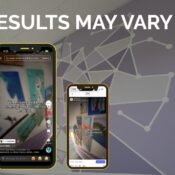
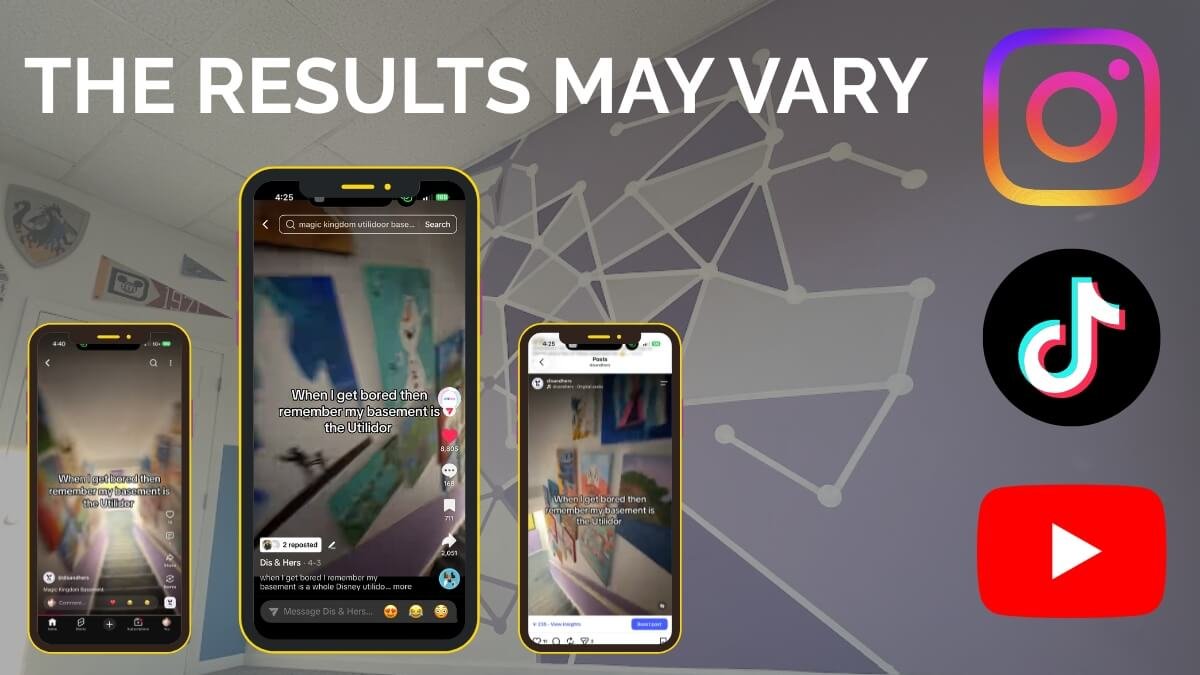
And it wasn’t a week later that we had a pretty big win. Thankfully we have a teenage daughter who is very up to date with the trends. She saw one of her posts go viral a month earlier (showing that she had a full-sized wrestling ring in our basement) and we enlisted her to do the same thing. This time, she was going to show off that our basement is themed like the famous Utilidor at Walt Disney World. That’s the underground tunnel system.
Much like her video, it blew up (for us at least). Beyond proving that we have the most interesting basement in America, it also proved something else. What worked on TikTok didn’t necessarily work on YouTube or Reels.
The video on TikTok received over 170,000 views, while that same video only received several hundred views on Reels.
But that’s not the only occasion. We’ve posted several hundred videos to date and some videos go big on Reels and get crickets on TikTok. Every now and then, one video does well on both – but it’s rare.
So what’s the big difference between the platforms? Same content, but wildly different results.
The Algorithms Aren’t the Same
The first thing to understand is that TikTok, Reels, and Shorts aren’t showing your video to the same people.
That sounds obvious, but it’s probably the biggest reason we are seeing such different results.
TikTok has always been built around discovery. You open the app and immediately land on the For You page. The platform doesn’t really care if you follow the person making the video. It cares if it thinks you are going to stop scrolling and watch.
That gives smaller accounts a pretty good opportunity. TikTok can take a video from an account with 500 followers, show it to a group of people who might like it, and then expand the audience if those people keep watching.
Instagram works a little differently.
Reels certainly gives you the opportunity to reach people who don’t follow you, but Instagram already knows a lot about your relationships. It knows who you follow, who you message, whose posts you like, what you share, and what accounts you regularly interact with.
That means Reels is mixing discovery with your existing social network.
And sharing seems to be especially important on Instagram. Does someone see your Reel and immediately send it to their spouse? Do they share it with a friend? Do they save it for later?
That could be a very different signal than simply watching the entire video.
Then there’s YouTube Shorts.
YouTube has an advantage that neither TikTok nor Instagram can completely duplicate. It might have years of information about what you watch and search for.
If you have spent the last decade watching videos about Disney World, YouTube knows that. If you regularly search for Disney news, ride construction updates, hotel reviews, and park history, YouTube has a pretty good idea that you might be interested in our content.
But YouTube also pays very close attention to whether you actually choose to watch the Short.
• Did you watch or swipe away?
• How long did you watch?
• What percentage of the video did you finish?
• Did you like it?
All three platforms look at many of these same signals, but they don’t necessarily weigh them the same way.
That means the question isn’t simply, “Is this a good video?”
TikTok might be asking if this is something that will stop you from scrolling.
Instagram might be asking if this is something you will watch and share with someone.
YouTube might be asking if this fits with everything else you have been watching.
So What Do You Do?
So the question sometimes comes down to how you should adjust your content for each platform. For our case, we won’t. Yes, the algorithms and audiences might be slightly different, but in the end, we are making a video that we find helpful, fun, or interesting.
Much like everything else, we don’t necessarily know if any video will hit or miss. Focusing and worrying about hitting on all three of these platforms is wasted energy.
When one hits on TikTok, we are happy. If it misses on YouTube, oh well. At least it hit on TikTok, right?
So our goal is to hopefully find a home and an audience on one of the three platforms, but not get so into the details that we worry if every single video is working or every single channel.
These algorithms often encourage frequency. It’s more important to have an efficient process that promotes quality content than to spend a ton of energy on one piece. We’ve found a way to make this happen.
And, to be honest, the short-form content isn’t the meat and potatoes. We are really looking to get people to find us on Apple or Spotify.
So if we get 100 views or 100,000 views, we are really looking to see if those downloads on the pod went up.
And if you are a fan of Disney, feel free to give us a subscribe or a listen.
Listen to Dis & Hers on Spotify
Listen to Dis & Hers on Apple Podcasts

Recent Posts
Nostalgia & Why It Sells