AI in Marketing: The Good, the Bad & the Gray Area
AI is a tool. It is not a replacement for your voice, your thinking, or your connection with your audience. That is the line Eric drew at the end of this month's episode and honestly, it sums up everything the team unpacked across 40-plus minutes of honest, unfiltered conversation.
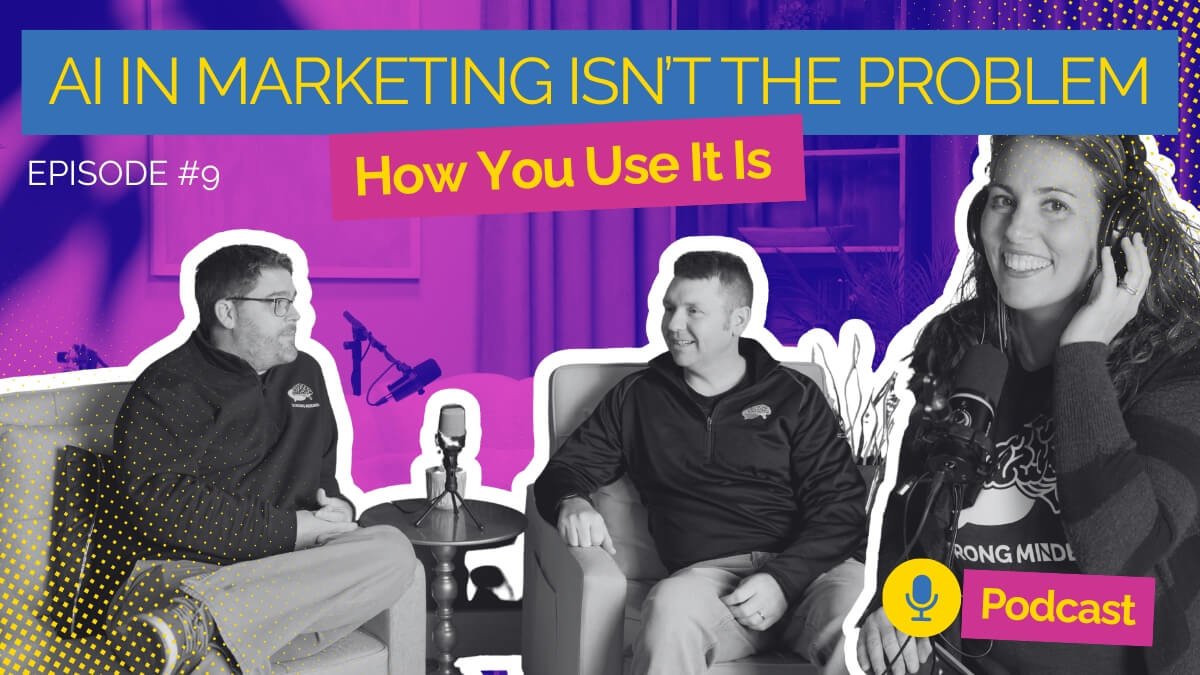
In Episode 9 of Meeting of the (Strong) Minds, Eric, Jenny, and Luke tackle one of the most talked-about (and most misunderstood) topics in marketing right now: AI. Not the hype version. Not the doom-and-gloom version. The real, day-to-day version where AI saves your afternoon but can quietly hollow out your brand if you are not paying attention.
Listen to the Full Episode
Prefer Apple? Listen and subscribe on Apple Podcasts.
The Good: Where AI Actually Earns Its Place
The conversation kicks off with a question Eric puts to the team: when did AI actually start making a difference in your work? For Jenny, the answer was simple. Efficiency. Tasks that used to eat up half a day now take minutes. Writing website content for a client in an industry you are not an expert in? Feed AI the research, the client's goals, the tone and suddenly every page has a thousand words of solid, tailored copy instead of 300 words of rushed filler.
Luke came to it more cautiously. A writer at heart, he was skeptical from the start and still is, in the best way. His sweet spot for AI is brainstorming and research: using it as a conversational jumping-off point rather than a ghostwriter. "The blank page is where it can be a really good resource," he says. Start with AI to break the paralysis, then make it your own.
Eric points to something that often gets overlooked: the grunt work nobody wanted to do in the first place. Background removal. Transcriptions. Extending a vertical image to fill a widescreen. These are the places where AI does not feel like it is taking anything away, because frankly, nobody was mourning those tasks.
"Something that would have taken four hours is done in just a few minutes. So that's major."
Jenny Snyder
The Bad: When AI Starts Costing You Trust
Here is where the conversation gets really interesting and where the team does not pull punches. The danger with AI is not that it produces bad work. It is that it can produce convincing work that quietly severs the connection between your brand and your audience.
Jenny puts it plainly: if people can tell your content is AI-generated, the copy that has not had a human look at it, the graphics with that glossy manufactured sameness, they lose trust in you. And in business, trust is the whole game. Luke takes it further, comparing it to getting an email where someone forgot to change the name in the template. The moment you clock it, the connection is gone.
There is also the hallucination problem. Luke is candid about this: the more you trust AI without checking it, the more confidently wrong it can be. It will not tell you it is guessing. It will just be wrong, positively, supportively, enthusiastically wrong. Staying disciplined about verification is not optional.
"Once you know that you're reading an AI prompt, there goes any heart, any personalization, any individualism. Your brand just becomes spam."
Luke Hladek
The Gray Area: It Depends on Your Brand, Your Market, and Your Moral Line
The most honest part of this episode is the team sitting in the discomfort of the gray area and not pretending there is a clean answer. Eric walks through a real scenario from the agency: a client who needs photos of something that does not exist in stock photography and cannot afford a photo shoot. Do you use AI-generated images? Is that the right call for their business? The team does not land on a definitive yes or no, because the honest answer is it depends.
Luke brings up a point that reframes the whole debate: every technology shift has felt like this. The pencil replaced the quill. Wikipedia was going to ruin research. Background removal in Canva is AI and we just do not call it that because we are used to it. The question is not whether AI is good or bad. It is whether what you are doing with it honours the connection your audience came for.
Jenny draws her line clearly: she is not willing to live in a world where creativity is replaced entirely, where graphic designers lose their jobs to a button-click, where the art goes out of the work. At the same time, she is using AI every single day. That tension is not hypocrisy. It is the reality of operating thoughtfully in a rapidly evolving landscape.
"Just be smart. Don't be fake. Do what makes sense for your brand and feels right. That all goes back to the core values of your business."
Jenny Snyder
The Strong Minded Agency Take
So where does the team land after all of it? Firmly in the hybrid camp, but with eyes open. AI is a tool, like Photoshop, like Premiere, like the spell checker before it. Use it to move faster, think bigger, and cut the work nobody wanted to do anyway. But do not let it replace your voice, your thinking, or the human connection that makes people choose you over everyone else.
And if you are writing blogs with AI and posting them without a single human thought in there? At Strong Minded Agency, the answer to that is still a hard no. "We're writing with our brains," Eric says. "Because that's what we offer to the world."
What This Episode Covers
- How the team first encountered AI and why Eric almost wrote it off as another fad
- The real efficiency wins AI delivers in content creation, web copy, and audio/video production
- Why AI hallucinations are still a serious risk if you stop checking your work
- What happens to brand trust when your audience can tell everything is generated
- The gray area scenarios including AI-generated photography, hybrid workflows, and case-by-case judgment calls
- Jenny's take on AI as an invasion of privacy including heat mapping, eye tracking, and social data collection
- Why the team believes a human touch is always non-negotiable
Follow & Subscribe
Want to keep up with the latest episodes? Follow Meeting of the (Strong) Minds wherever you listen or watch:
Have thoughts on AI in marketing? Tag us on Instagram, Facebook, or LinkedIn and join the conversation.

Recent Posts
Nostalgia & Why It Sells